
Posts Tagged ‘tax planning for high income earners’
The Medical Expense Reimbursement Plan (MERP) Guide for High-Earning Practice Owners

The formation of a C corporation brings many benefits to owners, and tax-free fringe benefits can save employees a lot of money. Learn the types of benefits that apply.
Read MoreC-Corp Arbitrage for Physicians: How S-Corp Doctors Unlock Tax-Free Fringe Benefits

The formation of a C corporation brings many benefits to owners, and tax-free fringe benefits can save employees a lot of money. Learn the types of benefits that apply.
Read MoreThe Self-Employed Health Insurance Deduction: The Physician’s Guide to Above-the-Line Write-Offs

The qualified business income (QBI) deduction represents potentially significant tax savings for your business. Learn whether you qualify and how to maximize this deduction.
Read MoreSection 179 and 100% Bonus Depreciation: The Physician’s Guide to Year-One Vehicle Write-Offs

The qualified business income (QBI) deduction represents potentially significant tax savings for your business. Learn whether you qualify and how to maximize this deduction.
Read MoreHow 1099 Physicians Can Legally Hire Their Kids and Save $11,000+ Annually

In a Nutshell Here is the main idea upfront. You work long shifts in patient care. You pay nearly half your revenue in high tax brackets. At the same time, you pay for sports gear, summer camps, and tutoring for your kids using personal funds. A physician family payroll strategy lets you turn those personal…
Read MoreThe Cost of Lazy Bookkeeping: How Separating Meal Ledgers Saves Doctors $1,480+ Annually

In a Nutshell The Trap: Lazy, retroactive bookkeeping groups all food-related costs into a single general “Meals” bucket, capping your deduction at a flat 50% across the board. The Power of Separation: By establishing a specialized, customized chart of accounts, you can separate employee events (100% deductible) from business development dining (50% deductible). The Active…
Read MoreThe Ultimate Guide to Owning a Short-Term Rental: Pros and Cons for Doctors

originally posted on :July 27, 2022 In a Nutshell Short-term rentals can generate significantly higher cash flow than traditional long-term properties, but they require active business management. For high-income medical professionals, the real power lies in a specific tax strategy. If your guests stay an average of seven days or less, the IRS views…
Read MoreIt’s How You Earn, Not How Much: A Physician’s Guide to Income-Type Tax Planning
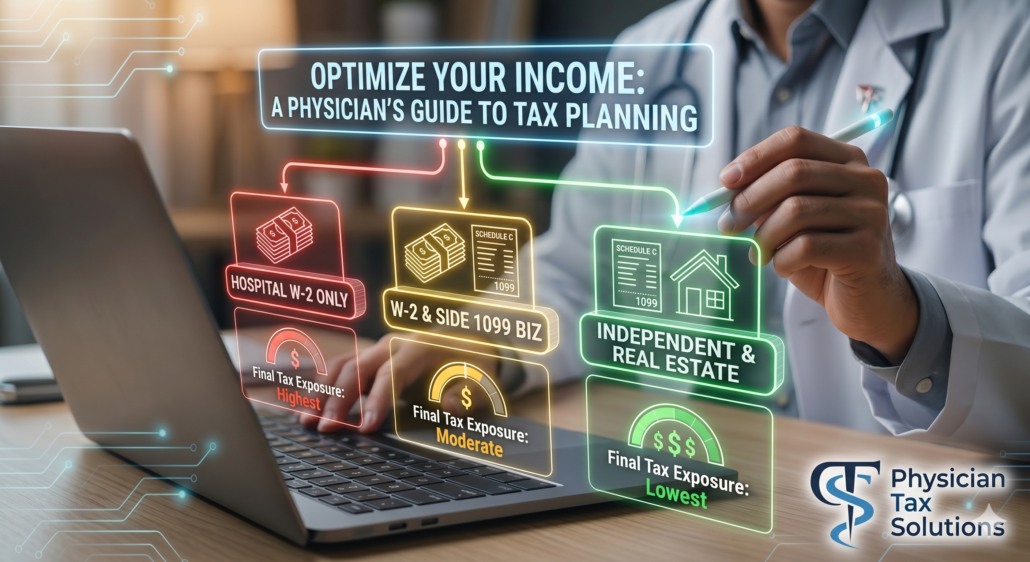
In a Nutshell The W-2 Trap: Employed doctors carry the heaviest relative tax burdens due to high ordinary brackets and a total lack of standard business deductions. The Core Shift: Your total tax liability depends entirely on how you make your money rather than the gross amount you earn. The 1099 Path: Adding even a…
Read MoreSold Nvidia, Apple, or Tesla Stock? Don’t Forget the Tax Bill

In a Nutshell If you sold shares of Nvidia, Apple, or Tesla and walked away with a profit, the IRS wants a piece. Here is the short version: Selling stock for a gain triggers a tax bill, even if you reinvest the money. Short-term gains (held one year or less) are taxed at your regular…
Read MoreWhy Tax Planning Matters More When You Have 1099 Income

In a Nutshell If you’re a physician with any 1099 income, the tax code gives you options that pure W-2 earners just don’t have. The three big moves are simple in concept: claim the deductions you already qualify for, set up the right business entity, then layer in advanced strategies once those basics are locked…
Read More