
Posts Tagged ‘tax planning for high income earners’
The Complete Guide to Quarterly Estimated Taxes

In a Nutshell Quarterly estimated taxes are payments you send to the IRS four times a year on income that doesn’t have taxes withheld. For 2026, the deadlines are April 15, June 15, September 15, and January 15, 2027. If you’re a doctor with side income, run a private practice, or work as a locum…
Read MoreW-2 and 1099 Physician Income Safe Harbor Rules: A Beginner’s Guide

In a Nutshell If you’re a physician earning income from both a hospital job (W-2) and side gigs like locums or telehealth (1099), the IRS expects you to pay taxes as you earn, not just in April. The irs safe harbor rule is your shield against underpayment penalties. Pay either 90% of what you’ll owe…
Read MoreS Corp vs Professional Corporation (PC) vs PLLC: What Physicians Need to Know

In a Nutshell Picking the right business structure as a physician isn’t just paperwork. It directly affects how much tax you pay, how protected your personal assets are, and whether your state will even let you operate the way you want. Here’s the short version: A Professional Corporation (PC) is a formal corporate structure that…
Read MoreSolo 401(k) vs SEP-IRA vs Defined Benefit Plans: Which Retirement Setup Wins for Physician S Corps

In a Nutshell If you’re a physician running an S corp with both W-2 hospital income and 1099 side work, your retirement plan choice can shift your tax bill by tens of thousands of dollars a year. A Solo 401(k) usually beats a SEP-IRA for physician S corps because it lets you contribute more on…
Read MoreHow to Determine a “Reasonable Salary” as a Physician S Corp Owner

In a Nutshell The IRS requires you to pay yourself a fair salary before taking distributions from your S Corp. “Reasonable” means what another physician with your specialty, experience, and workload would earn doing the same job. Pay yourself too little, and the IRS can reclassify your distributions as wages, plus add penalties and back…
Read MoreThe Basics of S Corps for Business Owners: A Physician’s Beginner Guide
In a nutshell: If you’re a physician running your own practice or doing locum work, an S Corp can lower your self-employment tax bill by splitting your income into a “reasonable salary” plus distributions. You only pay payroll taxes on the salary portion. It’s not magic, and it’s not for everyone, but for high-earning doctors,…
Read MoreW-2 and 1099 Tax Planning for Doctors: How to Handle Multiple Income Streams Without Overpaying

“Wait, how do I owe that much?” Dr. Patel looked up from her laptop and pushed it across the kitchen island. “I already had taxes taken out from my hospital paycheck,” she said. “So why does my CPA keep talking about quarterly payments?” Her friend, Dr. Nguyen, laughed a little. Not because it was funny,…
Read MoreTax Planning for Physicians with Multiple Income Streams: How to Stay Organized and Avoid Overpaying

“Taxes are what we pay for civilized society.” — Oliver Wendell Holmes Jr. That quote gets used a lot. Maybe too much. Still, it fits here. If you are a physician with more than one income source, taxes can get messy fast. A W-2 job. A 1099 side gig. Telemedicine work. Expert witness income. Maybe…
Read MoreQuarterly Tax Payment Dates: When Estimated Taxes Are Due and How to Stay on Schedule

“In this world nothing can be said to be certain, except death and taxes.” That line gets quoted a lot because, honestly, it still lands. For many physicians, the hard part is not knowing taxes exist. You already know that. The hard part is timing. You earn well. Your income may come from W-2 work,…
Read MoreSpecialized Tax Preparer for Physicians vs General CPA: What Makes More Sense?
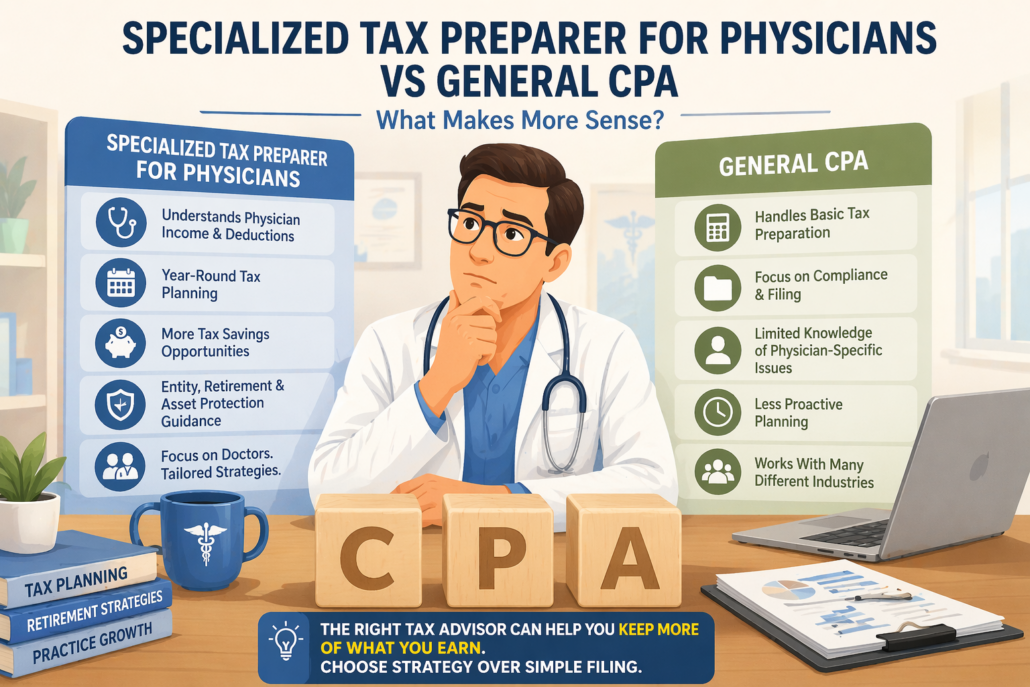
When a general CPA may be enough, and when a physician-focused tax advisor changes the picture If you are a physician, your tax situation can look simple from the outside. High income. W-2 job. Maybe a 1099 side gig. Maybe a practice. Maybe real estate. Maybe your spouse owns a business. At first glance, it…
Read More