
C-Corp Arbitrage for Physicians: How S-Corp Doctors Unlock Tax-Free Fringe Benefits
update August 28, 2026
In a Nutshell
-
Most independent doctors use a single S-Corporation to reduce self-employment tax, but IRC Section 1372 strips away standard tax-free employee fringe benefits for anyone owning more than 2% of the practice.
-
S-Corp owners end up paying for family healthcare co-pays, life insurance, and child care with personal dollars that have already faced top-bracket income taxes.
-
By adding a sister C-Corporation Management Services Organization (MSO), you can set up a dual-entity structure that unlocks fully deductible C-Corp fringe benefits for doctors.
-
The S-Corp pays a fair-market-value management fee to the C-Corp MSO. The C-Corp provides bona fide administrative services, pays for employee fringe benefits, and reduces its own taxable income to zero.
-
A specialized reimbursement timing strategy keeps your high-limit disability insurance payouts completely income-tax-free while securing a back-end corporate write-off.
-
Proper setup requires written plan documents, separate corporate records, fair-market pricing, and strict adherence to non-discrimination rules.
The Standard S-Corp Playbook and Where It Fails
Most independent physicians, private practice partners, and locum tenens doctors follow the exact same financial advice. You form an S-Corporation, take a reasonable W-2 salary, and pull the remaining practice profits as owner distributions.
This setup does save money on Medicare and self-employment taxes. For years, general practice accountants have called this the absolute ceiling of medical tax planning.
It is not.
Running your practice entirely through a single S-Corp leaves a massive blind spot on your personal balance sheet. You are forced to pay for substantial personal and family expenses out of your own pocket using after-tax dollars that were taxed at top federal rates of 37%.
Here is why this happens:
-
The Internal Revenue Code treats greater-than-2% S-Corp shareholders as partners for fringe benefit purposes under IRC Section 1372.
-
When your S-Corp buys you life insurance, covers out-of-pocket medical expenses, or reimburses child care, the tax code forces those perks back onto your personal W-2 as taxable wages.
-
Alternatively, the corporation loses the ability to deduct the payment as an ordinary business expense altogether.
-
You end up funding basic family security with expensive, post-tax income.
What Is C-Corp Arbitrage for Physicians?
C-Corporations operate under a separate set of tax rules than pass-through entities.
While S-Corps pass all net profits straight to your individual tax return, a C-Corp is a standalone corporate entity taxed at a flat federal rate of 21%. More importantly, a C-Corp can provide statutory employee fringe benefits that are 100% tax-deductible to the company and 100% tax-free to the employee receiving them.
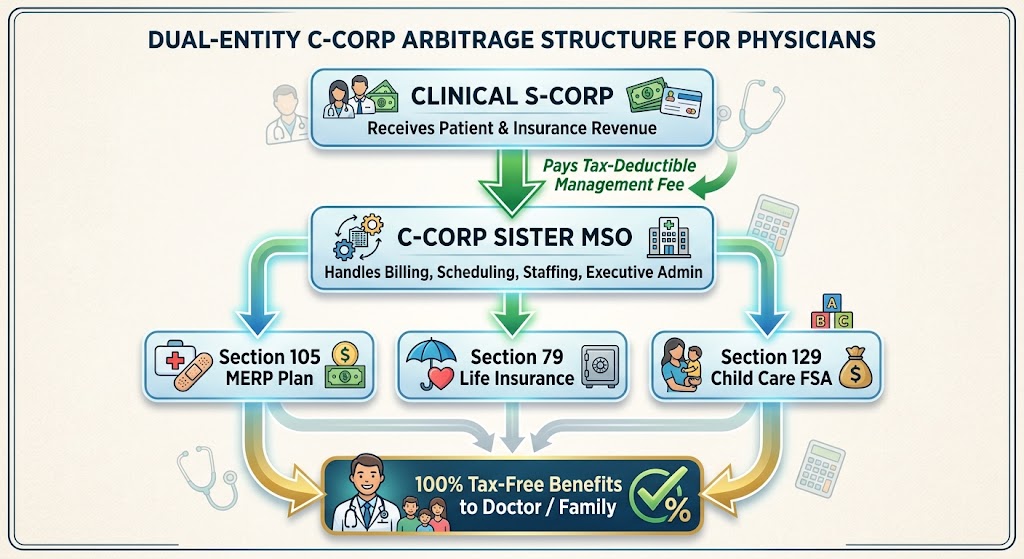
How physicians use a dual-entity C-Corp MSO to convert practice management fees into tax-free Section 105, Section 79, and Section 129 corporate fringe benefits.
A dual-entity structure pairs your existing clinical S-Corp with a sister C-Corp operating as a Management Services Organization (MSO).
-
Your S-Corporation delivers clinical patient care and collects practice revenue.
-
Your C-Corporation MSO provides administrative services: billing, marketing, regulatory compliance, scheduling, vendor management, and IT support.
-
The S-Corp pays an ordinary, fair-market management fee to the C-Corp MSO, creating a valid business write-off for the medical practice.
-
The C-Corp collects this fee as corporate income.
-
The C-Corp uses this revenue to fund comprehensive, statutory fringe benefit plans for its employees.
-
The C-Corp writes off the entire cost of these benefits, lowering its net corporate taxable income to zero.
-
You receive reimbursements and coverage personally without paying a single dollar of income tax on them.
Core C-Corp Fringe Benefits for Doctors
When you establish a properly structured C-Corp MSO, you gain access to statutory fringe benefit programs that are unavailable under a standalone S-Corp.
Section 105 Medical Expense Reimbursement Plans (MERPs)
A Section 105 MERP allows the C-Corp to reimburse employees for out-of-pocket medical, dental, and vision costs incurred by them and their dependents.
-
Deductibles, copays, and prescription expenses.
-
Comprehensive orthodontic care, dental implants, and cosmetic dental repairs.
-
Laser vision correction, prescription eyeglasses, and contact lenses.
-
Mental health therapy, physical therapy, and specialized medical treatments not covered by baseline health insurance.
These expenses are fully deductible for the C-Corp and completely excluded from your gross income.
Section 79 Group Term Life Insurance
Under Section 79, your C-Corp can pay for and deduct the cost of up to $50,000 in group term life insurance coverage for you. The premium payments are not reported as taxable wages on your W-2.
Section 129 Dependent Care Assistance
A C-Corp can establish a formal Dependent Care Assistance Program (DCAP).
-
Provides up to $5,000 (or $7,500 depending on active annual statutory limits) per year in tax-free support for child care, nursery school, after-school care, or elder care.
-
High-earning doctors routinely find themselves phased out of personal child and dependent care tax credits on their individual 1040 returns.
-
Setting this up through the MSO lets you fund these necessary family costs with corporate, pre-tax dollars.
Section 127 Educational Assistance Programs
Your C-Corp can provide up to $5,250 annually in tax-free educational assistance per employee.
-
Covers ongoing professional development courses, tuition, books, and necessary academic fees.
-
Includes qualifying principal and interest payments on existing student loans under current statutory extension provisions.
Section 132 Working Condition and Transportation Benefits
The C-Corp can cover a broad list of ordinary, work-related administrative expenses:
-
Executive parking up to the statutory monthly limit ($325 per month).
-
Qualified transit passes.
-
100% of dedicated corporate cell phones and secure communication lines.
-
Administrative travel, off-site board meeting travel, and required executive equipment.
The Look-Back Disability Insurance Strategy
Disability insurance is essential for practicing physicians. Your clinical hands and cognitive focus generate your revenue. But standard disability tax treatment creates a frustrating dilemma under IRC Section 104 and Section 105:
-
If your practice pays and deducts the premium: Any future disability insurance payout you collect becomes 100% taxable as ordinary income.
-
If you pay the premium personally: You do not get a tax deduction today, but any future payout is 100% tax-free.
If you become disabled after writing off your premiums for years, high-bracket income taxes will eat up a huge portion of your monthly benefit checks.
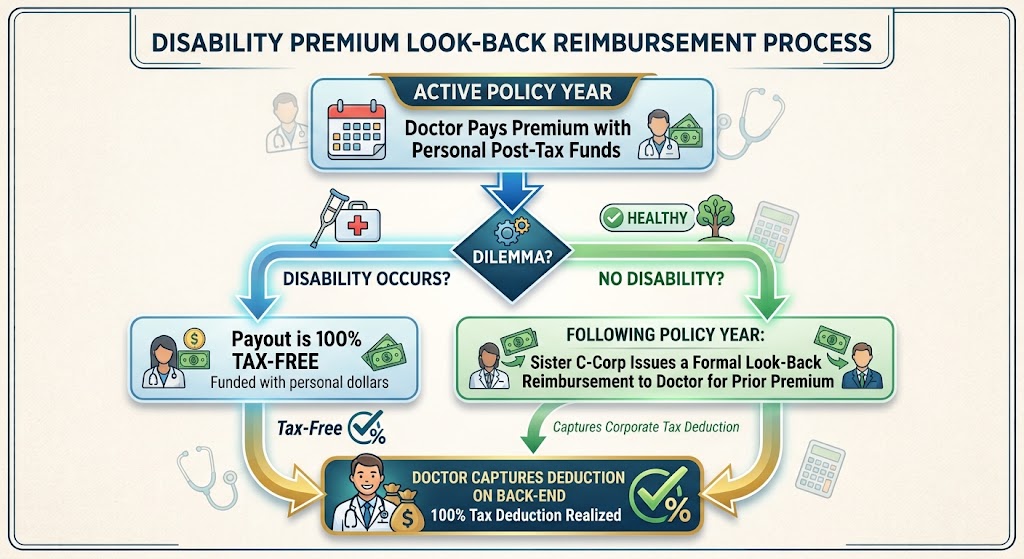
The look-back reimbursement strategy protects disability insurance payouts from income tax while securing a retroactive corporate deduction through a sister C-Corp.
The C-Corp MSO framework allows you to use a compliant look-back reimbursement strategy:
-
Pay personal funds first: You pay your individual own-occupation disability insurance premiums out of your personal, after-tax bank account during the active coverage year.
-
Protect the coverage window: If an injury or illness occurs during that policy year, your monthly disability benefits are received completely tax-free because you personally paid the policy carrying the risk.
-
Execute the look-back reimbursement: If you finish the policy year healthy, your C-Corp MSO reimburses you for that prior-year premium expense at the start of the next corporate term.
-
Capture the write-off: The C-Corp claims the ordinary business deduction on the back end. You protect your downside risk while recovering the business tax deduction.
Comparing the Numbers: Single S-Corp vs. Dual-Entity MSO
To see the real cash impact of this structure, assume you spend $25,000 each year on a combined package of out-of-pocket family medical copays, dental care, Section 79 life insurance, dependent care, and executive admin expenses.
Assume a top marginal individual tax bracket of 37%.
| Metric | Single S-Corp Structure | Dual-Entity C-Corp Arbitrage |
| Gross Personal Income Needed to Spend $25,000 | $39,682.54 | $0 (Funded via MSO) |
| Personal Income Tax Paid on That Spending | $14,682.54 | $0 |
| S-Corp Management Fee Deduction | $0 | $25,000 |
| S-Corp Tax Savings (at 37%) | $0 | $9,250.00 |
| C-Corp Taxable Income | N/A | $0 ($25k revenue – $25k fringes) |
| Net Cash Kept by Your Family | $0 | $23,932.54 |
Single S-Corp Setup
Under Section 1372, you cannot deduct or exclude these fringe benefits. You must pull enough money out of the practice to pay $25,000 in net cash after paying 37% tax.
Gross Income Required = $25,000/ 1 – 0.37} = $39,682.54
Tax Paid on Dollars Spent= $39,682.54 X 37% = $14,682.54
Dual-Entity MSO Setup
-
Your clinical S-Corp pays a $25,000 management fee to your sister C-Corp MSO, saving $9,250 on your S-Corp pass-through tax bill ($25,000 × 37%).
-
The C-Corp takes in $25,000 in revenue and spends $25,000 on approved, written fringe benefit programs. Corporate taxable income is $0.
-
You receive $25,000 worth of direct reimbursements and benefits tax-free.
-
You avoid paying the $14,682.54 in individual taxes you would have owed under the single S-Corp route.
Combining the $9,250 S-Corp deduction savings and the $14,682.54 in avoided personal taxes keeps $23,932.54 in your family accounts.
Compliance and Corporate Governance
The IRS looks closely at transactions between related corporate entities. You cannot simply move money between bank accounts and label it a management fee.
To make sure your dual-entity structure holds up against IRS review, put these core compliance standards in place:
1. Arm’s-Length Management Contracts
Your S-Corp and C-Corp must execute a formal, written Management Services Agreement.
-
The agreement must outline specific services the MSO provides: billing, staffing, marketing, electronic medical records administration, or facility management.
-
The fees charged must reflect fair market value. If a third-party billing and management firm charges 8% to 12% of collections for similar services, your internal MSO pricing should stay within that commercial range.
2. Independent Corporate Substance
Your C-Corp cannot be a paper shell company.
-
Obtain a distinct Employer Identification Number (EIN).
-
Open a dedicated commercial bank account used exclusively for MSO operations.
-
Keep separate general ledgers, corporate minutes, and annual board resolutions.
-
Document real administrative work performed by the MSO.
3. Formal Written Plan Documents
You cannot claim statutory fringe deductions through informal verbal agreements.
-
Draft and formally adopt written plan documents for your Section 105 MERP, Section 129 DCAP, and Section 127 educational assistance plans before issuing reimbursements.
-
Establish clear submission, review, and claim reimbursement procedures with actual receipts and invoices.
4. Non-Discrimination Rules
Fringe benefit programs have strict statutory non-discrimination rules under the tax code.
-
If your C-Corp MSO employs outside, non-owner administrative staff, your fringe benefit plans cannot disproportionately favor highly compensated employees or corporate owners.
-
Structure your employee classes carefully and run annual non-discrimination tests to ensure your plans remain fully qualified.
Frequently Asked Questions
Can I set up a C-Corp MSO if I am a solo physician?
Yes. Solo physicians, independent contractors, and 1099 locum doctors can establish an MSO to run their practice management, billing, and administrative oversight. The C-Corp must perform genuine administrative work to justify the management fees paid by the clinical entity.
Is an MSO structure legal in states with the Corporate Practice of Medicine (CPOM) doctrine?
Yes. The MSO model is the standard legal framework used to comply with CPOM regulations. In CPOM states, a general business corporation cannot practice medicine or employ physicians directly. The clinical practice is organized as a professional corporation (PC or PLLC) owned by the licensed doctor, while the non-clinical C-Corp MSO handles business support services.
How does this affect my Section 199A Qualified Business Income (QBI) deduction?
Most physicians are classified as a Specified Service Trade or Business (SSTB) and get phased out of the 20% Section 199A QBI deduction once their taxable income crosses upper statutory thresholds. Because high-earning doctors rarely receive the full QBI deduction anyway, shifting income via management fees to a C-Corp MSO creates clear tax savings without sacrificing 199A benefits.
What happens if the C-Corp earns more management revenue than it spends on fringe benefits?
Any net profit remaining inside the C-Corp at the end of the tax year is taxed at the flat 21% federal corporate rate. This is still substantially lower than the 37% top individual federal income tax bracket, giving you an opportunity to reinvest retained earnings into practice equipment, software, or expanded administrative infrastructure at a lower tax rate.
Taking the Next Step
Sticking to a single S-Corporation often means leaving significant tax savings on the table. Setting up a dual-entity C-Corp MSO lets you convert necessary family living costs, health care expenses, and insurance premiums into legitimate, tax-free business benefits.
Building an audit-ready structure requires careful planning, custom plan documents, and defensible transfer pricing. Schedule a consultation with our team at Physician Tax Solutions to review your practice structure, calculate your potential tax savings, and put a customized tax plan to work for your medical practice.
This post serves solely for informational purposes and should not be construed as legal, business, or tax advice. Individuals should seek guidance from their attorney, business advisor, or tax advisor regarding the matters discussed herein. Physiciantaxsolutions assumes no responsibility for actions taken based on the information provided in this post.